Scaling Agile for Large Enterprise Teams: What Actually Works
Agile works beautifully for small teams. When the enterprise gets involved, scaling agile isn't about doing more agile - it's a different problem.
Break down silos and ship faster with modern DevOps practices. We help you build automated CI/CD pipelines and infrastructure as code.
Most teams we meet can write code faster than they can ship it. The bottleneck is the release: a manual checklist, an environment that drifted from production, and nobody quite certain how to undo a bad deploy. The work is turning that into a pipeline, defining environments in code so they can be rebuilt rather than repaired, and making rollback something you have practised rather than something you hope works.
Automated pipelines and infrastructure defined in code, so a release is a routine event rather than a scheduled risk.
Build, test and deploy automated end to end, with linting, type checks and test suites gating a merge. Promotion through staging to production follows the same path every time, which is what makes a release boring.
Programmable environments using Terraform and Ansible. We treat your infrastructure like your applications - version-controlled, auditable, and reproducible across any cloud provider.
Container orchestration with autoscaling and health checks, so a failing instance is replaced without anyone being woken up. Kubernetes carries real operational cost, so it is worth adopting when the workload justifies it and not before.
Using Git as the single source of truth for both your application and infrastructure states. We implement ArgoCD and Flux for automated state reconciliation and simplified rollbacks.
Beyond basic monitoring. We build deep telemetry systems using Prometheus, Grafana, and ELK stack to provide real-time insights into system health, performance, and user experience.
FinOps practice: right-sizing instances, reviewing reserved capacity, and attributing spend to the workloads creating it. Cloud bills usually grow through accumulated defaults rather than one bad decision, so this is a recurring review rather than a one-off exercise.
Treating operations as an engineering problem: service level objectives agreed with you, error budgets that make reliability a trade-off rather than an argument, and blameless post-incident reviews that produce changes rather than blame.
Policy as code, so a deployment that breaches an internal standard fails in the pipeline rather than in a review meeting. The rule is written once and applied to every release, including the urgent one on a Friday.
What automated pipelines and infrastructure as code change about how you ship
Automated pipelines remove the manual checklist, so shipping on a Tuesday afternoon is unremarkable.
Infrastructure as Code removes the drift that makes staging pass and production fail.
Autoscaling and right-sizing, with spend attributed to the workloads creating it rather than arriving as one bill.
Automated rollback and health checks, tested before you need them rather than during an incident.
Engineers provision what they need through the pipeline instead of raising a ticket and waiting.
Architecture that adds capacity as load arrives, so operational effort does not scale with traffic.

A structured, multi-phase approach to modernizing your operations and delivery pipeline.
The automation and orchestration tooling we work with day to day
Deep technical analysis, architectural case studies, and strategic perspectives from our senior development teams.

Agile works beautifully for small teams. When the enterprise gets involved, scaling agile isn't about doing more agile - it's a different problem.

Choosing the wrong development partner is an expensive mistake. Here's how to approach the selection process in a way that actually predicts success.

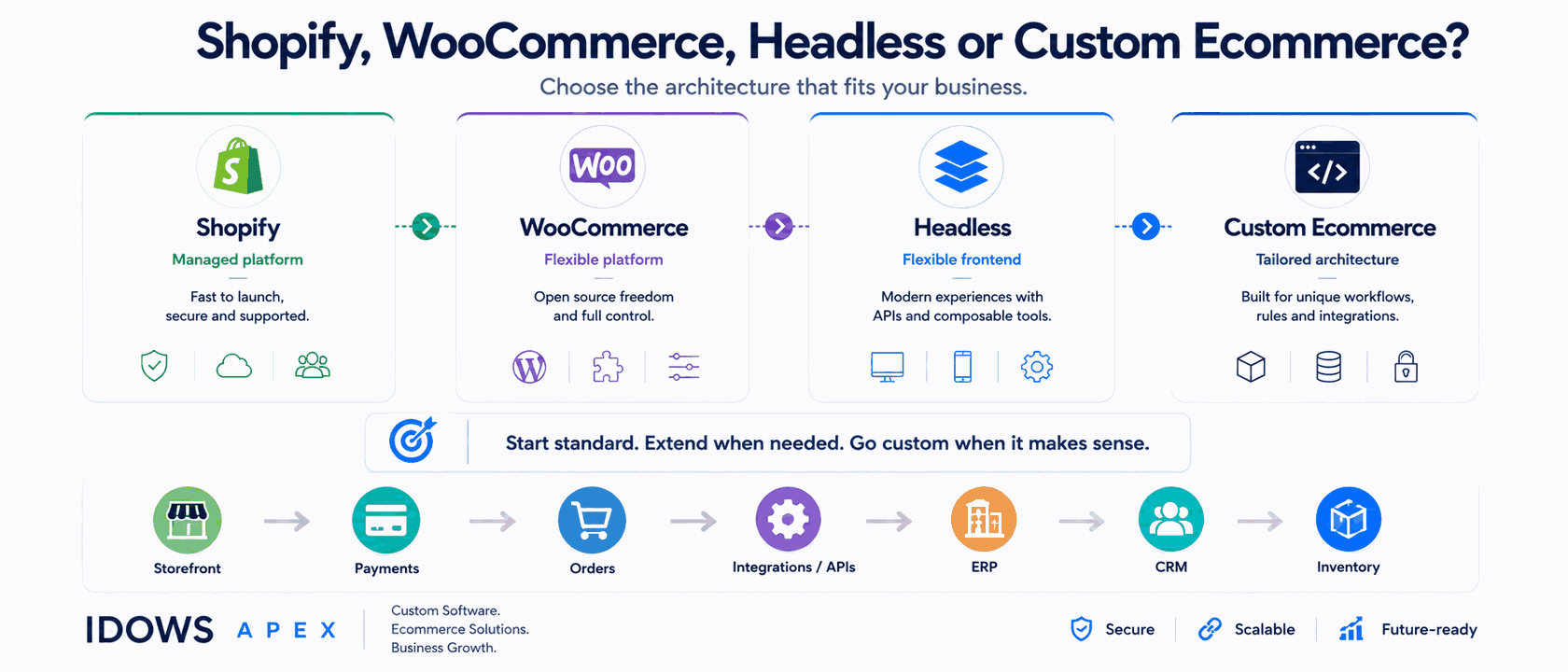
When Shopify or WooCommerce is enough, when to extend them, and when complex pricing, workflow or integration rules justify a custom ecommerce platform.
Related work that often sits alongside this one in the same engagement.