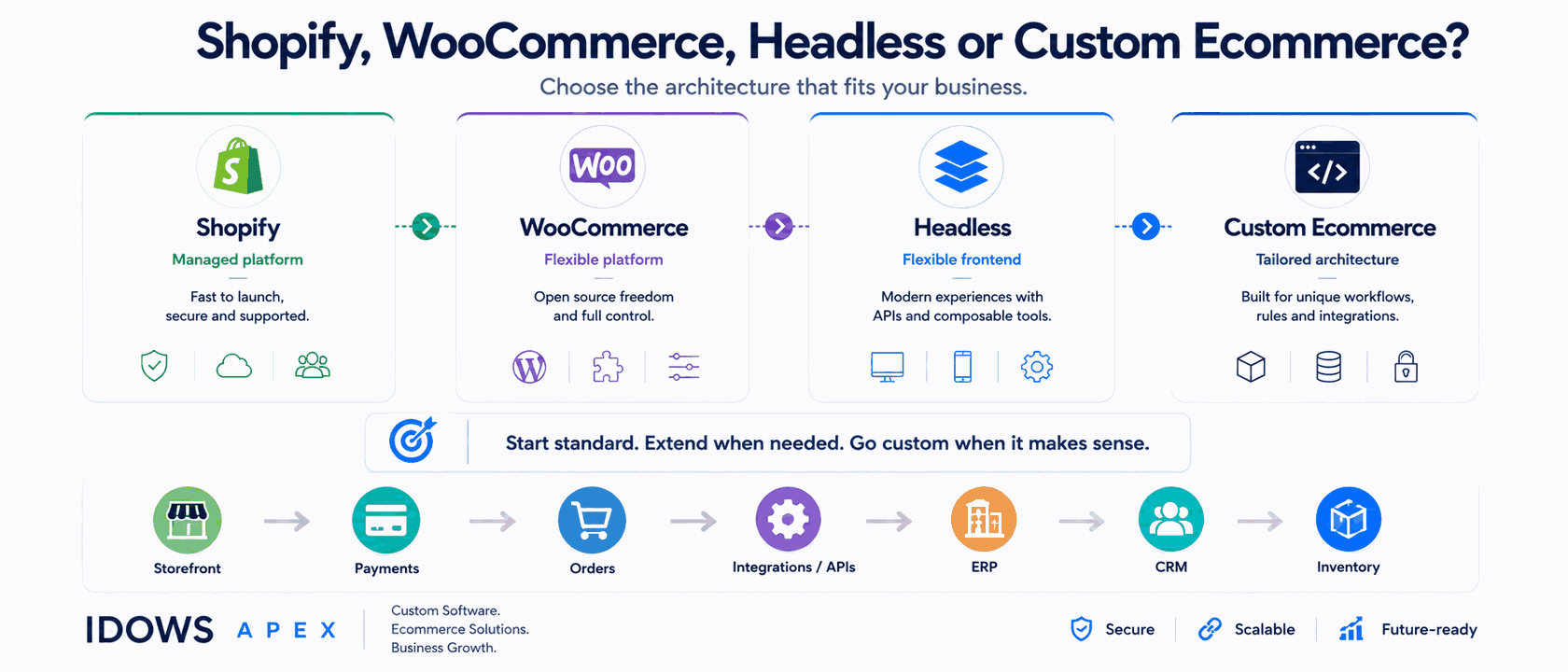
When Should You Choose Custom Ecommerce Over Shopify or WooCommerce?
When Shopify or WooCommerce is enough, when to extend them, and when complex pricing, workflow or integration rules justify a custom ecommerce platform.

Engineering high-performance digital infrastructure for strategic growth. We architect bespoke software solutions designed to transform your core workflows into scalable assets.

Most businesses do not need new software because the old software broke. They need it because the rules that matter cannot be expressed in the platform they bought, or because four systems hold the same data and none of them agree. IDOWS Apex is a team of senior engineers and solution architects who build and integrate the software that closes that gap - and who will tell you when an off-the-shelf tool would serve you better.
The team also includes techno-functional strategists. We don’t just write code; we architect resilient systems that scale with time, with a focus on legacy modernization and AI integration work.
Our work spans seven core services - custom software, AI agents, web applications, mobile apps, cloud systems, integrations, and legacy modernization. Most engagements touch three or four of them, because a store that cannot reach the ERP is an integration problem wearing an ecommerce costume.

Skilled
Development Team
3
Continents Served
20+
Technologies Supported
Flexible
Engagement Models
Enterprise software engineering for complex business systems. Seven core services, and most engagements use several of them, because the problems they solve rarely arrive one at a time.
View All ServicesSoftware built when the rules your business runs on cannot be expressed in anything you can buy. If a platform already covers your case, we will say so before quoting a build.
Custom AI agents wired into your systems, with scoped tool access and human approval where it matters. Agents take defined actions inside the software you already run, and route the consequential steps to a person.
Web applications in React, Next.js and Node.js. Most of the decisions come down to what renders on the server and what belongs on the client, and that is settled early because it is expensive to change later.
iOS and Android apps, native in Swift and Kotlin or shared through Flutter and React Native. Which one depends on how much the app leans on device hardware and background work.
Cloud-native applications on AWS, Azure and GCP, and staged migrations for systems that were never designed for the cloud. Infrastructure defined in code, so environments can be rebuilt rather than repaired.
Information architecture and user flows first, visual design after. Handed over as components and tokens developers can build from, rather than a flat file to interpret.
We build online stores around how a business actually sells - catalog structure, pricing rules, and the systems that hold inventory and customers. On Shopify, WooCommerce, Magento, Wix or OpenCart where a platform fits, custom where it does not.
Automated and manual testing across functional, API, performance and integration layers. Testing lowers the chance of a defect reaching production rather than removing it, and what it buys you is the confidence to release often.
CI/CD pipelines, container orchestration, and infrastructure as code. The goal is that a release stops being an event and becomes something you do on a Tuesday afternoon.
Aging systems moved onto maintainable architecture in stages, with reconciliation and a rollback path at each step. The rules encoded in an old system are usually the most valuable thing in it.
Three engagements, described in technical detail. Client names are withheld at their request, so what follows is the problem, the architecture, and the decisions behind it.
Scope, architecture and estimates are agreed before implementation starts, and changes are re-estimated rather than absorbed silently. That is what keeps a schedule honest.

Every project went through an in-depth discovery session where we collect the requirements. Afterwards, deliver the prototypes and based on the critical inputs from the client. This ensures the approved design is precisely aligned.


The stack below is what we reach for by default. Each of these is something we can staff, support, and debug under pressure, which matters more than whether it is the newest option available.
Deep, dedicated practices - not a checklist of buzzwords. Each technology area below is a real specialization with its own team and delivery track record.
From enterprise CRM to e-commerce and cloud platforms, we build on the systems businesses already rely on - configured, extended, and integrated around their requirements.
The processes behind the products - how we keep quality, security, and accountability consistent across every engagement.
Work is broken into two-week iterations with a demo at the end of each one, so you see working software on a fixed cadence instead of waiting for a single big reveal. Every task is tracked from ticket to deploy, and scope changes go through the same review as new work - nothing gets added silently.
Every pull request goes through peer review and automated CI checks - linting, type checking, and test suites - before it can merge. Features ship with unit and integration test coverage, and QA runs a manual regression pass on critical flows before any production release.
Dependencies are scanned for known vulnerabilities on every build. Secrets are never committed to source control and are managed through environment-level vaults. Access to production systems is role-restricted, and authentication flows are reviewed against OWASP guidance before launch.
Before implementation starts on anything nontrivial, we document the proposed approach - data model, service boundaries, failure modes - and review it as a team. This catches expensive mistakes on paper instead of in production, and gives you a written record of why the system is built the way it is.
Launch isn't the finish line. We offer defined support tiers with committed response times for production issues, scheduled dependency and security updates, and a direct line to the engineers who built your system - not a generic support queue.
Longer-form guides for teams evaluating a major technical decision - how we approach the problem, what tradeoffs matter, and how the pieces fit together.
Deep technical analysis, architectural case studies, and strategic perspectives from our senior development teams.

When Shopify or WooCommerce is enough, when to extend them, and when complex pricing, workflow or integration rules justify a custom ecommerce platform.

Practical AI agent use cases across five industries, and the operational metrics a business can use to judge whether automation is actually creating value.

From picking your highest-ROI use case to piloting and scaling: the end-to-end framework for deploying a custom AI agent for your business.
Tell us what is not fitting - the rule the platform cannot express, the systems that will not agree, the thing your team works around every week.