Build vs. Buy: When Does Custom Software Actually Make Sense?
Every growing business faces the same decision: buy off-the-shelf or build custom? It's a strategic choice with massive consequences for your bottom line.
A practical guide to eCommerce development — choosing the right platform, planning a custom build, and the integrations that turn a storefront into a real sales channel.
eCommerce development covers more ground than picking a platform and installing a theme. It spans platform selection, custom storefront and checkout engineering, catalog and inventory architecture, and the integrations that connect your store to payments, fulfillment, and the rest of your operational stack. This guide walks through how IDOWS Apex approaches each stage, and points to the specific platform and service pages relevant to your build.
What separates storefronts that convert from storefronts that just look good
We build on Shopify, Magento, OpenCart, and Wix, and recommend based on your catalog and growth plan — not whichever platform we happen to specialize in.
Every storefront decision is evaluated against checkout friction and page speed, because a beautiful store that loads slowly loses more revenue than a plain one that loads fast.
Platform migrations include a full URL redirect map and historical data transfer, so you keep the search rankings and backlinks you've already earned.
We build storefronts assuming they'll need to talk to an ERP, CRM, or marketing platform eventually — not as an afterthought once the first integration request comes in.
When a platform's data model genuinely can't support your pricing or fulfillment logic, we build custom rather than forcing your business into a workaround.
We stay on after launch for platform upgrades, security patching, and seasonal traffic scaling, so peak sales periods don't become incident response drills.
A methodical approach to delivering high-performance digital solutions.
We evaluate your product catalog complexity, pricing logic, and fulfillment workflow to determine whether a platform build or custom development is the right fit.
Where a platform makes sense, we match Shopify, Magento, OpenCart, or Wix against your catalog size, B2B needs, and existing tooling rather than defaulting to the most popular option.
We design the browsing, product, and checkout experience around conversion — minimizing friction at every step where a customer could abandon a purchase.
Development covers the storefront itself plus the integrations that make it operational: payments, tax, shipping, inventory sync, and CRM or ERP connections.
For existing stores, we execute the platform migration with a full redirect map and data transfer so search rankings and customer history carry over intact.
Post-launch, we monitor page speed and checkout conversion, treating both as revenue metrics worth continuous testing rather than one-time launch checkboxes.
The platforms and tooling behind every storefront we build
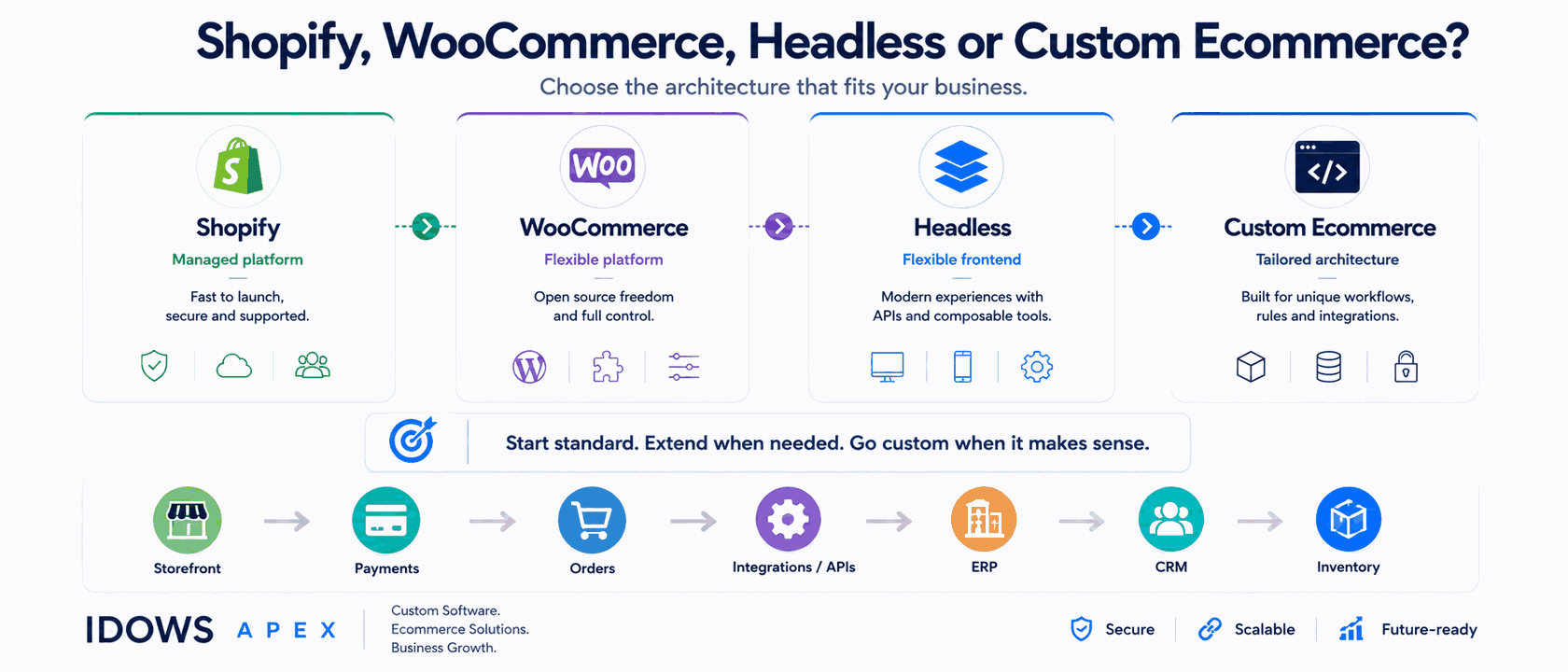
"eCommerce development" spans a much wider range of work than most businesses expect going in. At one end, it's picking a platform and configuring a theme — a project measured in weeks. At the other, it's a fully custom commerce engine with bespoke pricing logic, multi-warehouse fulfillment, and deep ERP integration — a project measured in months. Knowing which end of that spectrum your business actually needs is the difference between a store that ships on budget and one that either overspends on custom work it didn't need or under-delivers on a platform that can't support the business model.
For most catalogs, a platform is the right call. Shopify, Magento, OpenCart, and Wix each handle the undifferentiated heavy lifting — hosting, payment security, checkout compliance — so your team's effort goes into the product and customer experience instead of infrastructure. The right platform among those four depends less on feature checklists than on your catalog's complexity, your B2B or multi-currency needs, and how deeply you need to customize checkout and pricing logic. Custom development earns its cost only when a platform's underlying data model genuinely can't represent how your business actually sells — complex tiered pricing, unusual fulfillment splits, or a checkout flow no platform's app ecosystem can replicate.
Whichever path fits, a storefront is rarely the whole project. Payment and tax integrations are table stakes; inventory sync with a warehouse or ERP system, CRM connections for customer data, and marketing platform integrations are what turn a storefront into an operational sales channel instead of an isolated website. And if you're migrating an existing store, preserving your SEO rankings and order history through that migration matters as much as the new platform's feature set. The sections below cover our platform-specific practices and the supporting services — custom software, web engineering, and integrations — that make a commerce build complete.

Deep technical analysis, architectural case studies, and strategic perspectives from our senior development teams.

Every growing business faces the same decision: buy off-the-shelf or build custom? It's a strategic choice with massive consequences for your bottom line.
Explore our complementary expertise to accelerate your digital transformation journey.