Our Services

Ecommerce
Development

Ecommerce development for businesses whose requirements have outgrown a default store configuration.

Skilled
Development Team
3
Continents Served
20+
Technologies Supported
Flexible
Engagement Models

What We Do

We build online stores around how a business actually sells - the catalog structure, the pricing rules, the systems that hold inventory and customers, and the checkout paths that matter. On a platform where a platform fits, custom where it does not.

What We Build

Ecommerce Engineering

Few projects need all of this. Scope follows from what your catalog, pricing, and order workflow actually require.

01

Platform-Based Store Builds

Stores built on Shopify, WooCommerce, Magento, Wix, or OpenCart, extended where your requirements exceed what the platform ships with - not replaced because it did not fit on day one.

02

Custom Ecommerce

Bespoke commerce systems for businesses whose catalog model, pricing logic, or order workflow cannot be expressed inside a platform's data model without fighting it at every step.

03

Headless Commerce

A storefront built independently of the commerce engine and talking to it over APIs, for teams serving multiple front-ends from one catalog or hitting the ceiling of a theme system.

04

System Integrations

Connecting the store to ERP, CRM, accounting, warehouse, and fulfillment systems, with the conflict rules decided up front rather than discovered when two systems disagree about stock.

05

Platform Migrations

Moving an existing store onto a new platform with products, variants, customers, order history, and URL structure carried across deliberately, and redirects planned as part of the work.

06

Checkout & Payments

Gateway integration, and checkout changes where a business needs fields, validation, delivery windows, or approval steps that a standard flow does not provide.

07

B2B & Complex Ordering

Tiered and contract pricing, customer-specific catalogs, minimum order quantities, quote-to-order flows, and the approval steps that wholesale ordering usually requires.

08

Performance Engineering

Profiling, query work, and caching strategy for stores where catalog size, traffic, or accumulated third-party scripts have pushed a working configuration past comfortable.

Why Choose Us

What you get from a store engineered around your operation

01

Platform Advice Without a Stake

We build across five commerce platforms, so the recommendation is not shaped by which one we happen to sell.

02

Built Around Your Catalog

Product model designed from how you sell, rather than fitted to a default schema after the fact.

03

Upgrade-Safe Customization

Extension points and structured code, so a platform update does not quietly undo custom work.

04

Integrated With Your Systems

The store exchanges data with the systems that run the business instead of being an island staff re-key from.

05

Performance Treated as Engineering

Profiling and query work before caching, so the underlying problem is fixed rather than hidden.

06

Migrations That Keep Their Traffic

URL mapping and redirects are scoped into the work, because a migration that loses search visibility has not saved anything.

Our Process

How the work actually runs, from first conversation through to what happens after launch.

  1. 1

    Discovery

    Catalog structure, pricing rules, order workflow, integrations, and the constraints that shape all four.

  2. 2

    Platform Decision

    Platform, extended platform, custom, or headless - argued from your requirements, with the trade-offs written down.

  3. 3

    Commerce Architecture

    Product model, taxonomy, pricing logic, and where custom code is warranted versus a maintained extension.

  4. 4

    UX & Storefront Design

    Storefront and checkout design informed by how your customers actually buy, not by a theme demo.

  5. 5

    Development

    Built to the platform's coding standards so the work survives core, theme, and extension updates.

  6. 6

    Integration

    Connecting to the systems that hold inventory, customers, and finance, with defined conflict handling.

  7. 7

    QA & Launch

    Functional, checkout, and cross-device testing, then a controlled cutover with URL mapping and a rollback path.

  8. 8

    Optimization

    Post-launch performance and conversion work driven by real traffic rather than assumptions.

Approach

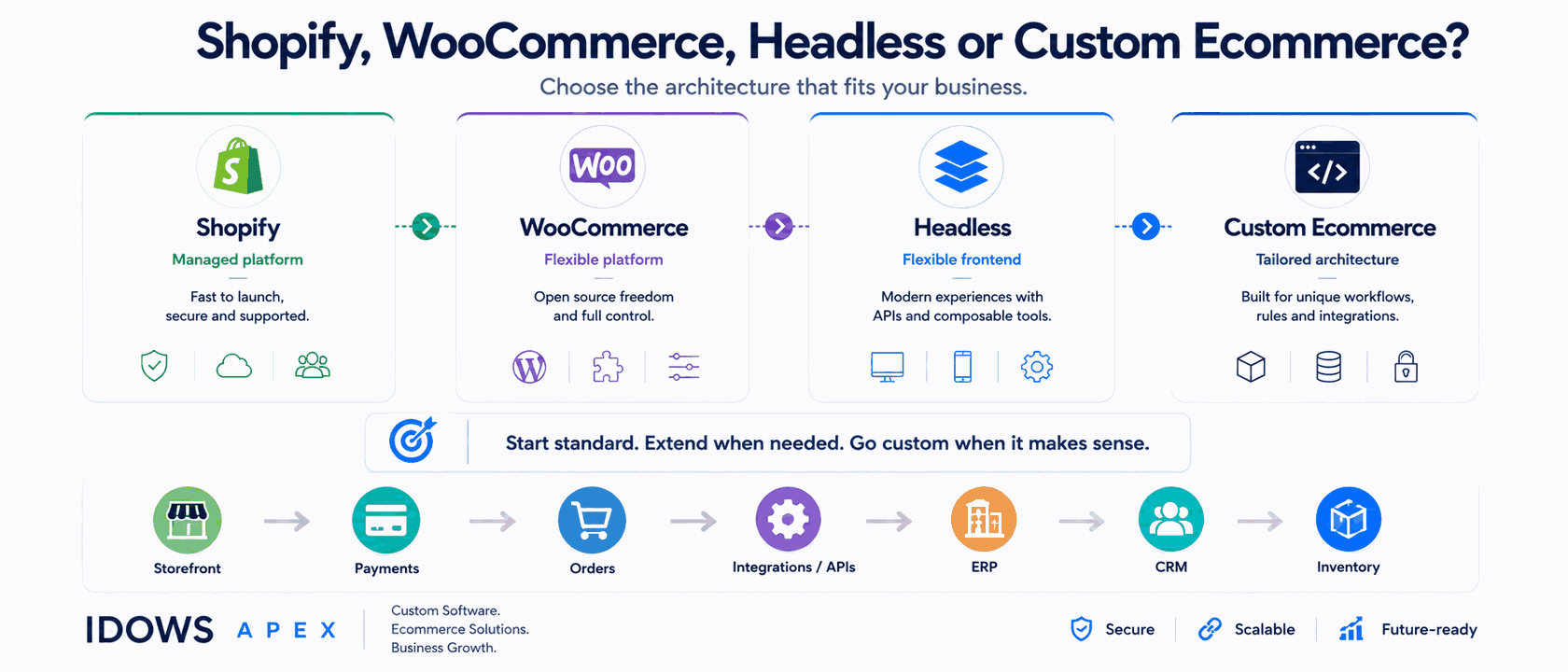
Platform, Extended, or Custom

This is the decision that shapes cost and maintenance for years, and it is worth making on evidence rather than preference.

Start on a platform

For most stores this is the right answer and stays the right answer. A platform you extend carries a maintained upgrade path, a payment and shipping ecosystem, and a security posture you are not personally responsible for.

Extend the platform

The middle ground where most real projects live. Custom themes, purpose-built extensions, and integration layers built against the platform's extension points, so a core update does not undo the work.

Build custom

Justified when the rules a platform cannot express are the rules your revenue depends on - unusual catalog models, pricing that changes per contract, or an ordering workflow that spans several systems before an order is even accepted.

Go headless

A separate decision from platform-versus-custom. Worth the added build and maintenance cost when several front-ends share one catalog, or when storefront performance is a commercial problem rather than an irritation.

If you would rather form your own view before talking to anyone, our guide to choosing an ecommerce platform works through the trade-offs, and we have written separately on when a custom build is justified over Shopify or WooCommerce.

When Headless Earns Its Cost

Headless commerce separates the storefront from the commerce engine. The storefront becomes an application in its own right, talking to the platform over APIs, which means you are building and maintaining two things instead of one. That is a real cost, and it should buy something specific.

It usually does when several front-ends share one catalog, when the storefront experience you need is not reachable inside a theme system, or when page performance is a commercial problem rather than an irritation. Where the requirement is app-like behaviour on mobile without an app store, a progressive web app layer is often the cheaper way to get most of the benefit.

For a single conventional storefront it usually adds build and maintenance cost without returning it, and we will say so rather than sell the more interesting architecture.

Business Logic

Where Default Configurations Run Out

The requirements that turn a store build into an engineering project are rarely on the storefront. They are in the rules behind it.

Pricing that is not a single number

Tiered rates, per-customer contract pricing, volume breaks, and regional tax treatment - ordinary in wholesale and largely absent from default configurations.

Orders that span systems

An order that has to create a record in an ERP, reserve stock in a warehouse system, and notify a fulfillment partner is a workflow, not a checkout setting.

Approval and quoting

Quote-to-order flows, purchase-order payment terms, and orders that need internal sign-off before they are accepted rather than after they are paid.

Catalog complexity

Configurable products, bundles, made-to-order items, and variant structures deep enough that the storefront needs to guide the customer through them.

Data that lives elsewhere

Inventory, pricing, or customer records mastered in another system, which makes synchronisation and conflict handling part of the store's architecture rather than a plugin setting.

Fulfillment rules

Multi-warehouse routing, delivery windows, split shipments, and the returns handling that follows from all three.

Connecting the Store to the Business

A store that does not exchange data with the rest of the business creates manual work rather than removing it. Orders need to reach finance, stock levels need a single source of truth, and customer records need to match the accounts your team already manages. Each of those is integration work with its own failure modes, and each needs an answer to what happens when two systems disagree.

Where operations run on an ERP, the commerce layer and the ERP are designed against each other rather than bolted together afterwards. Where the surrounding software does not exist yet - portals, pricing engines, internal tooling - that is custom software built alongside the store.

Migrations

Moving a Store Without Losing It

A migration is a data problem before it is a design problem. The mapping between the old model and the new one is where the risk sits.

Platform to platform

Moving between hosted and self-hosted commerce, usually because ownership, cost structure, or extensibility requirements have changed. The data model mapping comes before anything moves.

Legacy or unsupported store

Stores on a platform that is no longer maintained, or where the vendor has changed direction. Business logic worth keeping is rebuilt against the new platform rather than discarded.

Custom build to a platform

Bespoke stores where the maintenance cost has outgrown the benefit of owning every line. Moving onto a maintained platform is often the cheaper long-term position.

Products, variants, customers, and order history move together, and URL structure is mapped before cutover so existing search visibility survives the change.

Performance and Scale

Stores rarely slow down because of raw traffic. They slow down because of query patterns that were fine at a thousand products and are not at fifty thousand, uncached work on paths that run on every request, and third-party scripts that accumulated one marketing decision at a time.

We profile before changing anything, because a caching layer dropped over an unresolved query problem hides it until the next growth step. What gets measured is agreed before the work starts, so improvement is demonstrable rather than asserted.

Insights & Updates

Latest Insights& Technical Updates

Deep technical analysis, architectural case studies, and strategic perspectives from our senior development teams.

Frequently Asked Questions

Ready to Get Started?

Tell us what your current systems will not do. If an existing platform already covers it, we will say so.

Expand Your Reach

Discover More Services

Related work that often sits alongside this one in the same engagement.