Scaling Agile for Large Enterprise Teams: What Actually Works
Agile works beautifully for small teams. When the enterprise gets involved, scaling agile isn't about doing more agile - it's a different problem.
Shift security left. Scanning, secrets management and policy checks run inside the pipeline, so problems surface at commit time rather than in an audit.
Security review at the end of a project finds the same problems as security review during it, except later and more expensively. DevSecOps moves those checks into the pipeline, so a vulnerable dependency or a committed secret fails the build instead of reaching a report. By shifting security left, we catch vulnerabilities during development, automate compliance, and build a resilient foundation for your most sensitive applications.
Security checks that run as part of the build, not as a review stage after it.
SAST, DAST and secret scanning wired into the build. Every commit is checked automatically, and the pipeline fails on findings above an agreed threshold. Scanners catch known classes of problem, not every problem, so this reduces risk rather than removing it. It reaches your staging and production environments.
Security policy applied to Terraform and Kubernetes configuration, so firewall rules, IAM policies and VPC settings are reviewed as code rather than adjusted by hand in a console and forgotten.
Rigorous scanning of base images and third-party dependencies. We implement SBOM (Software Bill of Materials) tracking and binary authorization to prevent supply chain attacks and zero-day exploits.
Continuous monitoring mapped to SOC 2, HIPAA, or GDPR control requirements. We replace periodic manual evidence-gathering with dashboards that track control status continuously, so your security posture is visible without pulling developers off delivery work.
HashiCorp Vault for secrets, with dynamic injection and short-lived credentials so nothing sensitive sits in code or a plaintext environment variable. Credentials that expire on their own limit what a leaked one is worth.
Incorporating security analysis into the early design phase. We work with your architects to identify potential attack vectors before a single line of code is written, saving weeks of remediation time.
Findings routed into Jira and Slack with a severity that reflects exploitability in your context, not just the raw CVE score. A scanner that reports everything at critical gets ignored within a week, which is worse than no scanner. It works on real-world risk scores.
Protection that follows your code into production. We implement eBPF-based monitoring and adaptive firewalls that detect and block anomalous behavior in your clusters in real-time.
Why security-conscious leaders trust IDOWS Apex for their mission-critical security integration
Identify and resolve vulnerabilities during development, where they are cheapest and easiest to fix.
Automated evidence collection and policy enforcement, so control status is tracked continuously instead of reconstructed before an audit.
Security checks run alongside the test suite, so they add confidence rather than a separate approval stage.
Empower developers with automated security tools that provide immediate, actionable feedback.
Hardened infrastructure and minimized dependencies to drastically reduce your attack surface.
Build confidence with your customers and regulators through demonstrably superior security practices.

A defined methodology for shifting security left and achieving continuous compliance.
The scanning, secrets and policy tooling we work with day to day
Deep technical analysis, architectural case studies, and strategic perspectives from our senior development teams.

Agile works beautifully for small teams. When the enterprise gets involved, scaling agile isn't about doing more agile - it's a different problem.

Choosing the wrong development partner is an expensive mistake. Here's how to approach the selection process in a way that actually predicts success.

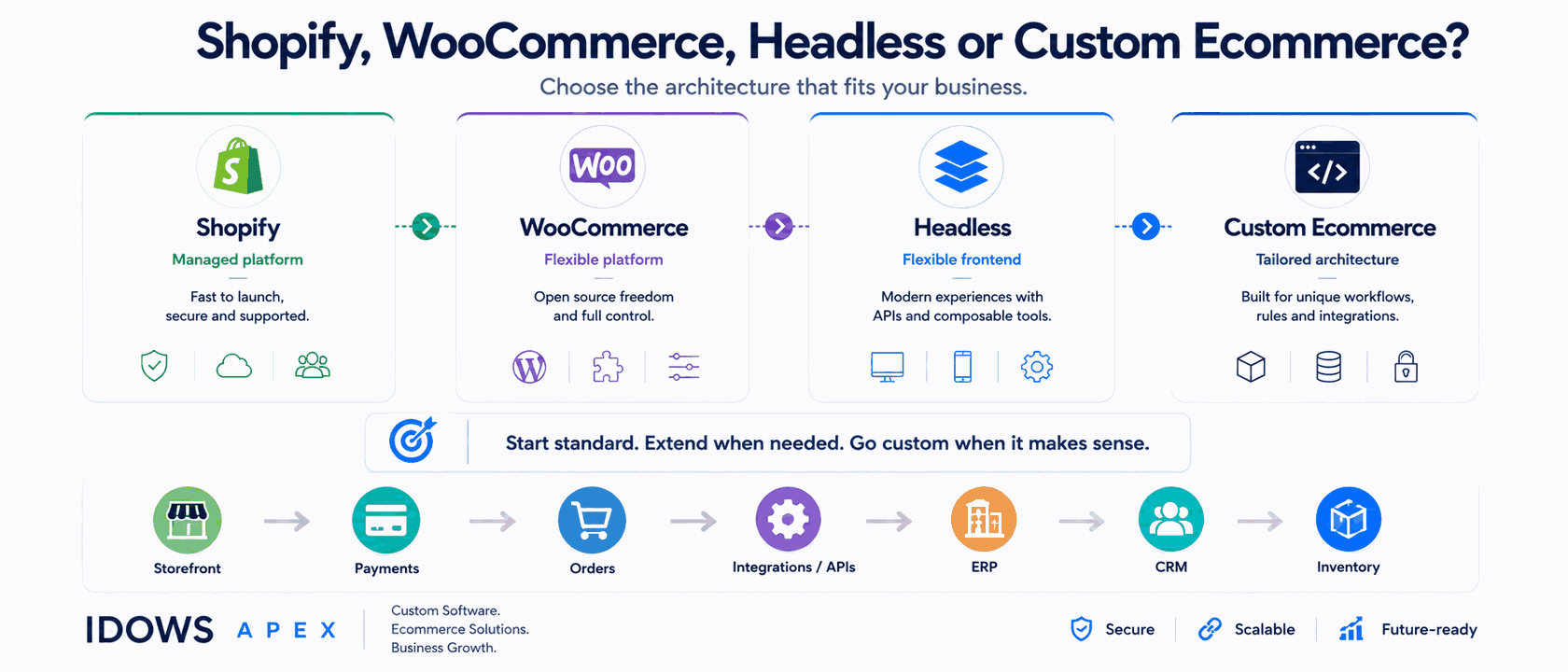
When Shopify or WooCommerce is enough, when to extend them, and when complex pricing, workflow or integration rules justify a custom ecommerce platform.
Related work that often sits alongside this one in the same engagement.