Scaling Agile for Large Enterprise Teams: What Actually Works
Agile works beautifully for small teams. When the enterprise gets involved, scaling agile isn't about doing more agile - it's a different problem.
From foundational concepting to global development, we oversee the entire product lifecycle with a focus on long-term market viability and technical precision.
This is the engagement where one team is accountable for the whole thing: discovery, architecture, implementation, testing, deployment, and what happens after launch. It suits organizations without an in-house engineering function, or with one that is already committed elsewhere. Where you do have that capability, a dedicated team or staff augmentation is usually the better structure, and we will say so.
What gets handed over is a codebase your own engineers can pick up: documented architecture, a test suite that runs in the pipeline, and deployment that is scripted rather than remembered.
Working out what to build before working out how. That means agreeing which problem the first release solves, what is explicitly out of scope, and how anyone will know whether it worked.
Microservices or a modular monolith, chosen for the team and the load rather than the fashion. A well-structured monolith is the right starting point more often than it gets credit for, and it can be split later along boundaries you have actually observed.
Our SMEs develop pixel-perfect interfaces and high-performance APIs with a unified workflow. Using agile sprints, we deliver functional software as promised and iterate based on the client’s inputs.
Research, user flows, and interface design with accessibility considered during design rather than audited afterwards. Retrofitting keyboard navigation and contrast onto a finished interface is consistently more expensive than building it in.
We embed QA throughout the development lifecycle to catch any vulnerabilities before they reach production. Our multi-layer approach covers every aspect of delivered solutions for peak performance.
CI/CD pipelines with the tests, checks and deployment steps automated, so releasing is a routine action rather than an event. Infrastructure defined in code, so environments can be rebuilt rather than repaired.
Automated monitoring and maintenance after launch, with alerting configured against the paths that carry real traffic. Most performance problems appear once usage patterns settle, which is after the launch window rather than during it.
Our engineers optimize the codebase and plan infrastructure scaling to meet business demands. Whether it's horizontal or vertical, our systems are built to scale on demand.
Architectural changes and version upgrades rolled out in phases, with a rollback path at each one. Deeper modernization work is covered under Legacy Modernization.
Why brands trust us with their entire product lifecycle.
No handover between a design agency, a build shop and a hosting provider, and no argument about whose defect it is.
The people who agreed the requirements are the people who build against them, so less is lost in translation.
One set of technical decisions across the codebase rather than three sets inherited from three suppliers.
The parts most likely to go wrong get identified during architecture, when changing course is still cheap.
Infrastructure chosen for the load you have, with the cost modelled before it is provisioned.
The team that built it is still there when you need the next change, so nobody re-learns the codebase.

Our disciplined execution model brings architectural stability and rapid data-driven deployment.
Engineering depth across every layer of the modern stack
Deep technical analysis, architectural case studies, and strategic perspectives from our senior development teams.

Agile works beautifully for small teams. When the enterprise gets involved, scaling agile isn't about doing more agile - it's a different problem.

Choosing the wrong development partner is an expensive mistake. Here's how to approach the selection process in a way that actually predicts success.

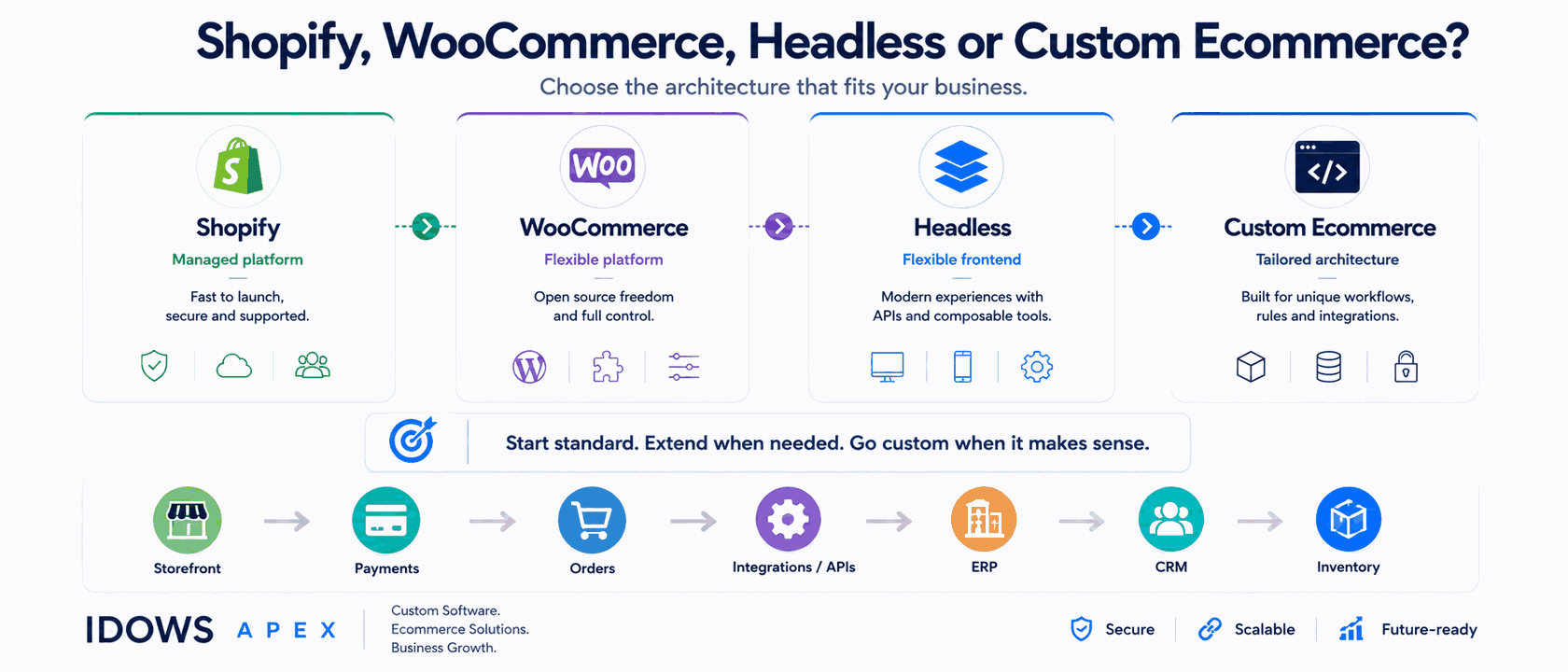
When Shopify or WooCommerce is enough, when to extend them, and when complex pricing, workflow or integration rules justify a custom ecommerce platform.
Related work that often sits alongside this one in the same engagement.